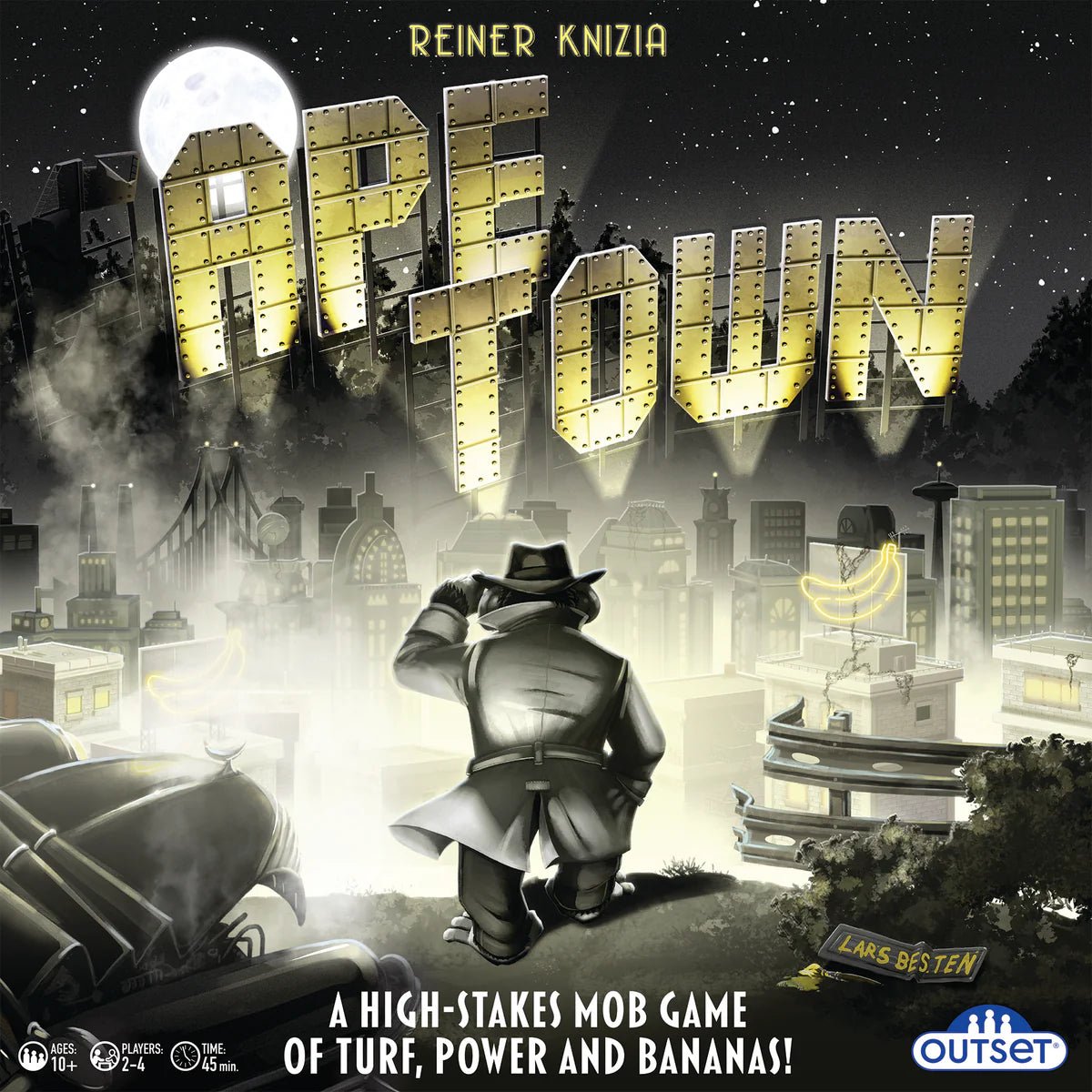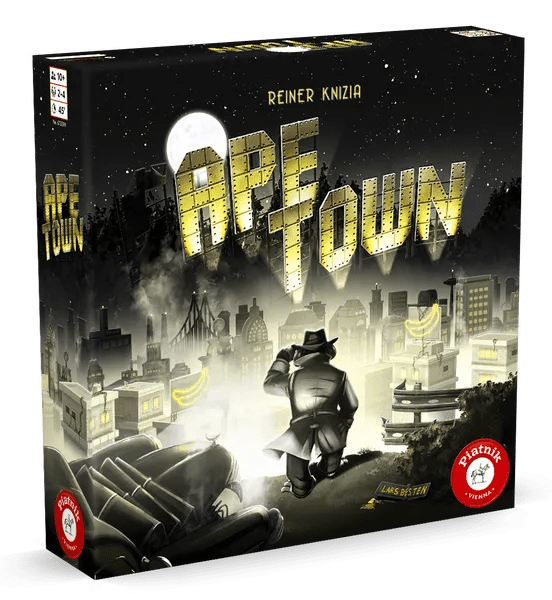


he humans left. The apes moved in. Now five rival gangs — chimpanzees, tarsiers, mandrills, orangutans, and lemurs — are fighting for control of the city's districts, and the only currency that matters is bananas.
Ape Town is a tile placement and area majority game by legendary designer Reiner Knizia, wrapped in a game-noir skin that makes it unlike anything else on your shelf. Each turn you pick a tile from a shared row — the first one is free, but skipping tiles costs you money bundles, which you collect back when someone else takes the tile you passed on. Place your tile on the matching district and score immediately, or play for territory control and cash in when a district fills.
The tension is in the two scoring modes running simultaneously. Monkey tiles (tarsiers, chimpanzees, mandrills) score right away based on adjacency — fast, tangible points. Orangutans and lemurs score nothing immediately, but when a district completes, the player with the most orangutans takes a big territory payout. Lemurs go further still, triggering scoring in neighbouring inferior districts and swinging the game in ways that can feel ruthless if you're not watching them.
It plays in under an hour, teaches quickly, and rewards players who can think two or three turns ahead. A strong choice for anyone who likes abstract strategy with just enough theme to keep it interesting.
What People Are Saying
"Simple to learn yet hard to master... enjoyable and satisfying when trying to plan a few turns in advance." — Lana Godfrey, @boardgameduck on Instagram
"A clever tile selection mechanic — keep a tight grip on your bundles of cash so you can play the right tile at the right time." — @getintogames on Threads
- Reviewed by Mike DiLisio at The Dice Tower (video review)
- Designed by Reiner Knizia — one of the most decorated board game designers of all time, known for clean mechanics and deep replayability
Game Mechanisms
Tile Placement The board fills one tile at a time, and every placement matters. Tiles must go in the district matching the colour of the row segment they came from, so your options shift as the game progresses. The board is always visible and all information is public — the challenge is reading what's coming next and positioning yourself before a rival beats you to the space you need.
Area Majority / Influence Districts score when they're full, and the payout goes to whoever has the most orangutans there. Getting majority in a key district requires commitment — those tiles score nothing until the district closes — but the reward can be enormous. Managing how many orangutans you're spreading across the board versus cashing in on immediate monkey points is the central decision the game asks you to make on every single turn.
Tile Selection Economy The shared tile row has a built-in cost system that's deceptively clever. The first available tile is always free, but if you want something further along, you pay one money bundle for each tile you skip — and those bundles sit on the skipped tiles until someone takes them. Pass on a good tile and you're essentially funding your opponent's future turn. It creates a constant tug-of-war over tempo and value that runs underneath every other decision in the game.